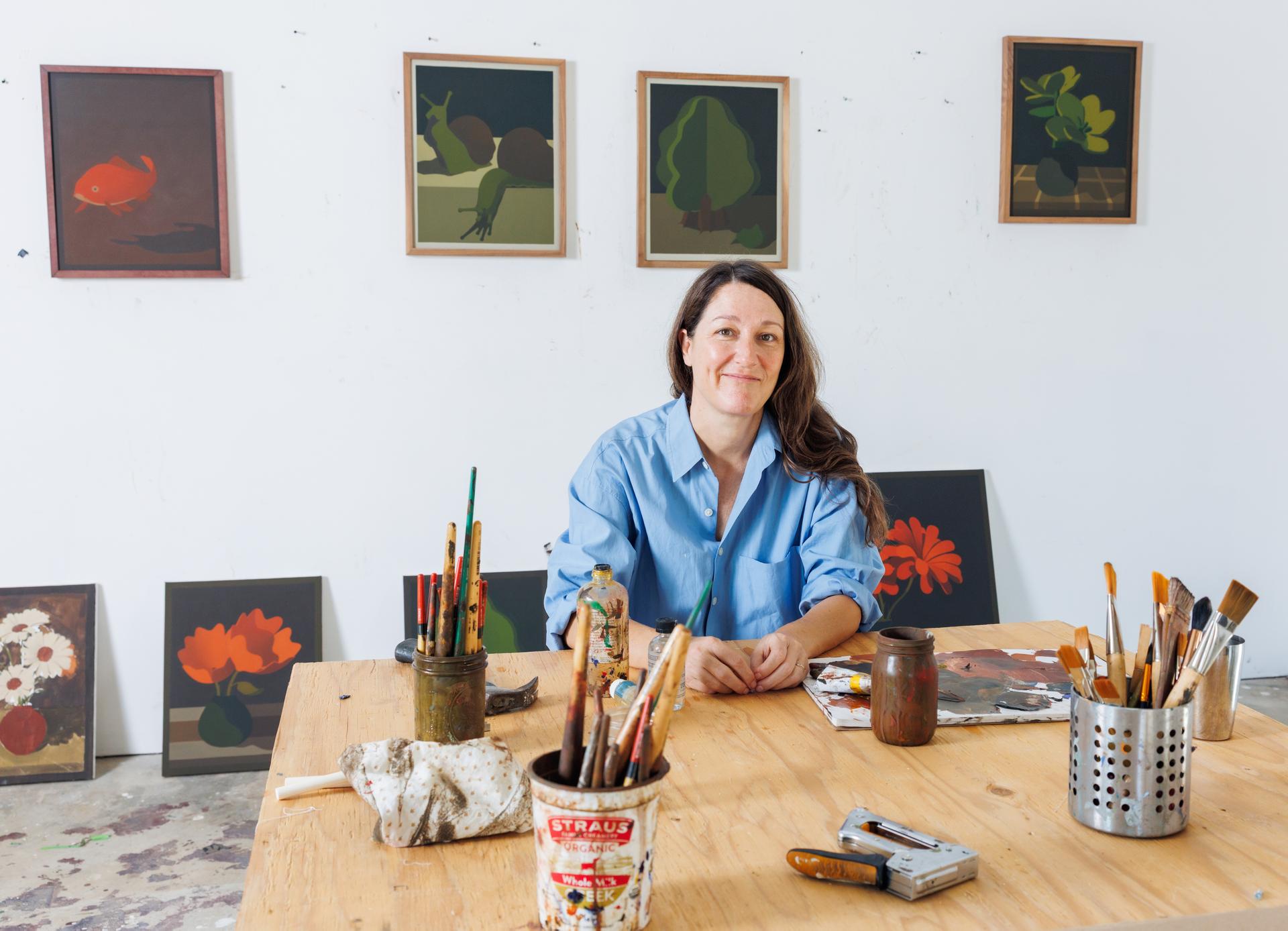
Jessica Silverman is pleased to announce representation of Laeh Glenn, a California painter whose work explores life, death, and the visceral power of painting in a culture largely mediated by screens. "A big part of my work is culling from the afterlife of online images and resuscitating them in the real world," Glenn says. “I take the chaos of our visual culture and distill it into something quiet and potent.” Through these means, Glenn manifests a pictorial world that feels both haunted and palpable, vintage and futuristic, modest and universal.
As it happens, Glenn grew up inside a painting. Her mother was an artist who didn’t have much time for furniture but insisted on painting every ceiling and wall of their home. Shortly after her mother’s death in 2003, Glenn began painting as a form of “magical thinking” – a way to stay in touch. At first, each invisible brushstroke was an elegy for loss. Then Glenn’s practice opened up to a broad range of emotions and themes, including art, technology, and nature.
When Glenn begins a new painting, she works from what she calls "orphan images," such as 3D models built to populate video games, advertising, and architectural renderings. She often finds her subjects – a flower, a house, a landscape, an animal – stranded in a flat gray void without context. Glenn restores material presence by giving code-generated images a setting they never had, like a table, a shadow, or a horizon line. Through these means, Glenn creates a tactility and permanence absent from digital experience.
Before Glenn turned to painting, she was a printmaker. That training persists in her work today: she builds her paintings one flat layer of color at a time, assembling form from individual shapes rather than blending or modeling. "The idea of embedding an image and repeating it stems from that undergraduate degree," she says. Glenn’s devotion to repetition across a narrow set of subjects recalls Josef Albers, Giorgio Morandi, and Tomma Abts, each known for finding variation within self-imposed constraints.
Glenn keeps her palette as disciplined as her subject matter, mixing nearly every color from red, yellow, blue, and brown, with sparing use of white. "I want all of these paintings, whose imagery is sourced from disparate times and places, to feel connected," she says. “They all learn to speak the same language.” Her colors do more than unify her oeuvre; they interrogate it. In three Snails paintings (2026), Glenn repeats the same composition in blue, green, and red, holding the image constant while allowing color to transform its character.
Glenn thins her paint until it loses most of its binder, producing a flat, matte surface she describes as moving the work from image to sculpture. Her frames extend that transformation. Few painters make their own frames; Glenn makes all of hers. Rather than enclosing the sides of the canvas, they sit over its face, concealing the painted edge. Inside the wooden frame, Glenn paints another frame, a dark border that functions like a quotation mark, acknowledging her appropriation.
Though her subjects are recognizable, Glenn paints them as an abstract artist would, collapsing any firm distinction between the two modes. Rose (2026) builds an uncanny bloom from velvety layers of petals that do not stack the way a living flower naturally would. In Green Tree (2026), the canopy of leaves is composed of a few flat shapes of green set one inside the next, each a shade darker than the last, like the rings of a contour map.
Glenn’s paintings do not reject digital images so much as test what happens when they acquire a body. Indeed, twenty years of engagement within a fixed set of motifs has produced something Glenn did not set out to make: a record of the internet’s changing visual language – from the launch of Google Image Search, with all the personal photographs that populated early online archives, to the 3D models and AI-generated images of today.
Jessica Silverman will present a selection of Glenn's work at Art Basel Paris, October 23–25, 2026. Her first solo exhibition with the gallery opens in May 2027.
Image credit: Jonah Reenders, courtesy of Laeh Glenn and Jessica Silverman, San Francisco