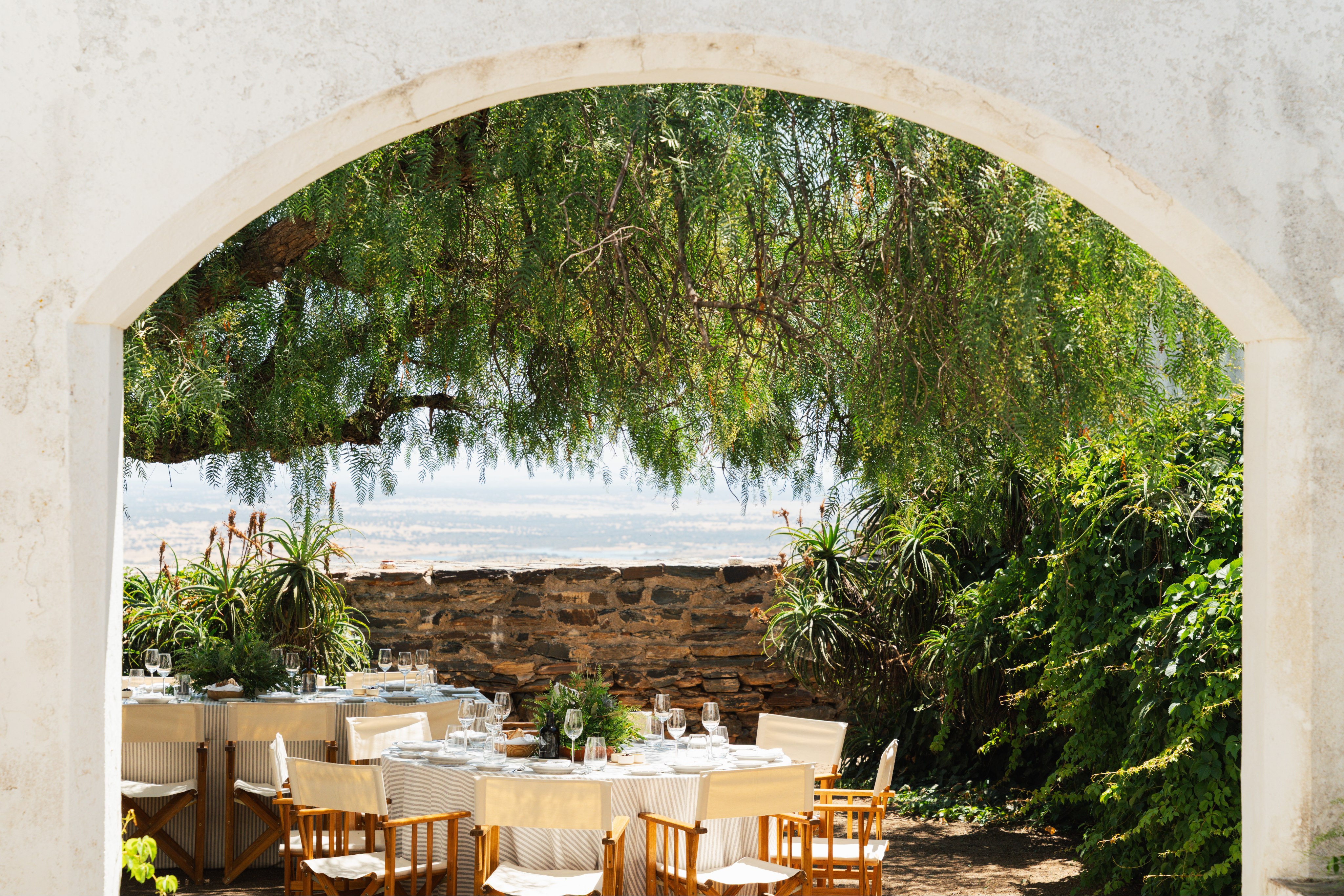
Some places announce themselves loudly. Others reveal themselves slowly. São Lourenço do Barrocal has always belonged to the latter.
2026 marks ten years since opening as a hotel; however, when São Lourenço do Barrocal welcomed its first guests in 2016, it marked the beginning of a new chapter in a much older story. Set within 780 hectares of vineyards, olive groves, cork forests and ancient holm oaks in Portugal's unspoilt Alentejo, São Lourenço do Barrocal has been shaped by the rhythms of the land since the early nineteenth century. For generations, it was a self-sustaining community where farming, craftsmanship and family life existed side by side. That changed in the 1970s, when political upheaval and the forced collectivisation of farms left the estate deserted, and its buildings slowly fell into ruin.
Working alongside Pritzker Prize-winning architect Eduardo Souto de Moura, archaeologists, designers, local craftspeople and biologists, José António Uva spent fourteen years painstakingly restoring Barrocal. The ambition was never simply to create a hotel, but to revive a working estate: preserving its agricultural heritage, protecting its biodiversity and creating a place that could once again sustain a community. For José António, this anniversary is not just about celebrating the hotel’s success but about celebrating eight generations of stewardship, and a long restoration process that brought a once-abandoned farming community back to life. Throughout this journey, every decision has been shaped by the belief that the estate is held in trust for future generations, with meaningful hospitality inseparable from a healthy landscape and a thriving local community. Reflecting on the milestone, Uva says:
"We didn’t originally set out to build a luxury hotel. We wanted to restore a place that mattered. Every decision we've made has been guided by the belief that we are only temporary custodians, caring for this landscape so future generations can inherit it in better condition than we found it. My hope is that, two hundred years from now, Barrocal will still be evolving with the same respect for the land, the people and the traditions that have always defined it."
Today, agriculture remains at the heart of daily life. Vineyards continue to produce wine, centuries-old olive trees provide the estate's olive oil, cattle graze beneath the cork oaks and the changing seasons shape everything from the kitchen to the guest experience. Luxury is found not in excess but in authenticity, simplicity and a profound sense of place.
That long-term approach has quietly earned international recognition. Over the past decade, the estate has received a Michelin Key, been named Best Hotel in the Iberian Peninsula in the Condé Nast Traveler Readers' Choice Awards and featured on the publication's Gold List. São Lourenço do Barrocal has also joined The Leading Hotels of the World, where José António Uva received the Uncommon Vision Award, and the estate was recognised with the Sustainability Leader Award. Its Susanne Kaufmann Spa has been celebrated by Monocle, while Eduardo Souto de Moura's restoration has become an internationally admired example of architectural conservation. The accolades are not the ambition, but the natural consequence of a steadfast commitment to the estate's character, architecture and landscape.
Among the commemorative projects planned for this milestone year is the release of Milenar, a limited-edition olive oil produced from the estate's ancient groves, including olive trees that are more than a millennium old. The celebrations will also include the publication of Natural Atlas, a beautifully curated volume inspired by research undertaken by the estate's in-house biologist, Nuno Guégués, who spent more than a year documenting and cataloguing the extraordinary biodiversity found across Barrocal. Beautifully illustrated with hand-drawn depictions of the estate's flora and fauna, the book documents its birds, mammals, reptiles, insects, pollinators and plant life, reflecting years of careful observation and scientific study. It is both a celebration of the landscape as it exists today and a commitment to protecting it for generations to come. Together, these projects reflect the estate's enduring commitment to preserving its natural heritage while celebrating the rich landscapes that have shaped it for generations.
Looking ahead, Barrocal continues to deepen its commitment to regenerative farming, biodiversity, craftsmanship and local culture. The ambition is not to become bigger, but to become deeper, ensuring the estate remains as relevant to future generations as it has been to the eight that came before.
As São Lourenço do Barrocal enters its second decade as a hotel, it does so with the perspective of a place that has already weathered centuries. Its story has never been one of reinvention, but of continuity, patience and care. Ten years is an important milestone, but for Barrocal it is simply the beginning of the next chapter.
Image courtesy of São Lourenço do Barrocal