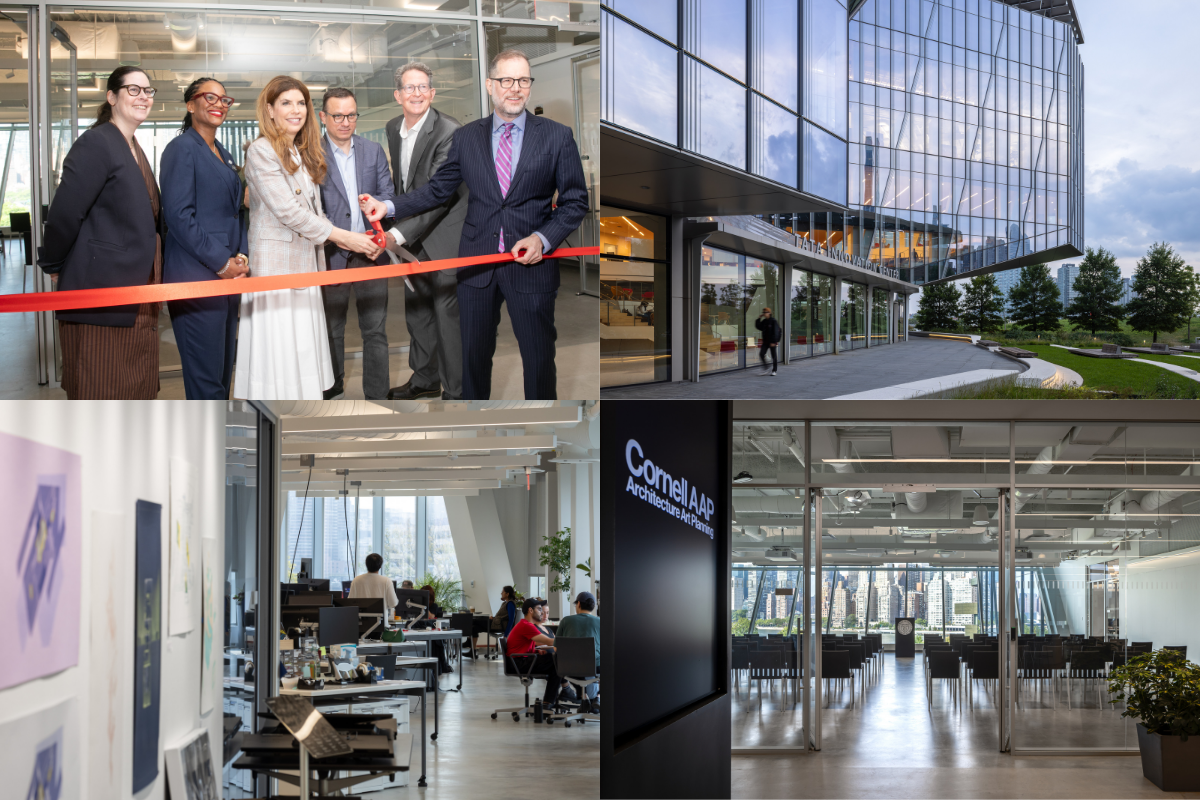
Cornell Tech, the AI Campus of New York City, celebrated the opening of new state-of-the-art spaces for academic programs and research, marking the completion of a year-long, nearly 60,000-square-foot renovation within the Tata Innovation Center on Roosevelt Island.
Held during the city’s annual 2026 NYCxDESIGN festival, the event marked the first time that the building’s entire fourth floor, designed by global architecture firm NBBJ, was opened to the public. Much of the fourth-floor space is dedicated to the Gensler Family AAP NYC Center, which is part of the Cornell University College of Architecture, Art, and Planning (AAP). The Center hosts students from eight programs — spanning architecture, urban design, and urban planning — and expands the campus’s interdisciplinary ecosystem through studio work at the intersection of the built environment and technology. The Gensler Family AAP NYC Center, which originally opened in 2006, moved earlier this academic year into the Tata Innovation Center space from its previous location in downtown Manhattan.
The new facilities are also the Cornell Tech home for the Cornell master’s degree program in Design Tech, a transdisciplinary, two-year degree program taught by faculty from five Cornell University entities — Cornell AAP, Cornell Tech, the Cornell Ann S. Bowers College of Computing and Information Science, Cornell Human Ecology, and the Cornell Duffield College of Engineering. Master’s students in the program spend their first year in Ithaca and can choose to spend the second year on the Cornell Tech campus, working with both Cornell Tech and AAP NYC faculty and labs. The first cohort of students who completed the program on both campuses will graduate from Cornell this year.
The milestone was celebrated with a ribbon-cutting ceremony featuring Cornell Tech Jack and Rilla Neafsey Dean and Vice Provost Greg Morrisett; Executive Director of the Gensler Family AAP NYC Center Robert Balder, who spoke on behalf of Meejin Yoon, Gale and Ira Drukier Dean of the College of Architecture, Art, and Planning (AAP) at Cornell University; alongside other leaders from academia, government, community, and industry.
“Since opening Cornell Tech in 2012, we have significantly expanded our capacity to innovate at the intersection of design, architecture, and technology,” said Morrisett. “It’s been especially exciting to welcome the first cohort of our new Design Tech program and to see this space come to life with architects, AI researchers, industry leaders, and public officials. Together, they represent the kind of cross-disciplinary collaboration that drives impact both locally and globally and defines us as the AI campus of New York City.”
The fourth floor also houses research labs focused on electrical and computer engineering and mobile and ubiquitous computing, enabling collaboration across disciplines. The other new spaces in the Tata Innovation Center also include a new coworking space called The Bridge, a new MakerLAB, a lab dedicated to health tech research, as well as the Blassberg-Rice Center for Entrepreneurship Law, which gives Cornell Tech law students who choose to spend a semester at Cornell Tech an opportunity to work with clients in the New York City area — a first for the law school’s Cornell Tech curriculum.
“This venue expands opportunities for experimentation and engagement across disciplines and in collaboration with our colleagues at Cornell Tech,” said Executive Director of the Gensler Family AAP NYC Center Robert Balder. “The Gensler Family AAP NYC Center has always been about providing our students with opportunities to immerse themselves in the city, engage with its complexities firsthand, and learn from scholars and practitioners who are actively shaping urban spaces across scales and contexts. As we settle into our new home, it’s encouraging that we’re already seeing students bring critical perspectives to their work, expanding the possibilities of their creative practices and sharing that knowledge with civic and community leaders.”
Attending the event were city officials, including New York City Council Speaker Julie Menin; New York City Comptroller Mark Levine; Deputy Borough President of Queens Ebony Young; and New York City Economic Development Corporation (NYCEDC) Senior Vice President of Innovation Industries Daria Siegel. Also attending was Audrey Tannen, district office director for New York State Senator Liz Krueger.
Following the ceremony, attendees participated in a guided tour highlighting cutting-edge studios, collaborative workspaces, and classrooms built to support experimentation across architecture, art, and advanced design technologies — including projects developed by students in these programs.
The expansion represents a continued investment in New York City’s future, strengthening Cornell Tech’s partnerships with city agencies, industry leaders, and the broader academic community.
Image credit: Cornell Tech and © NBBJ