Early in your career as a freelance marketing communications consultant, every yes can feel like a lifeline—but not all clients are created equal. In this candid reflection, Melissa Rosenfield, Founder of IFP Communications and author of the Substack, In Fine Print, shares how mistakes made early in her freelance journey forced a fundamental reconing of how she evaluates clients, revealing that the real risk was misalignment. Drawing on her path from consultant to agency founder, she unpacks the hard lessons learned from choosing the wrong partners and the questions that reshaped her approach, offering a timely reminder that building a sustainable PR career is as much about discernment as it is about saying “yes”.

Early on as a freelancer, I lost $13,000 a month in 60 days. It forced me to rethink how I work with clients.
The real mistake wasn’t the money but the clients I chose. These three questions changed everything.
If you’ve ever said yes to the wrong client just to make rent, this one’s for you.
I started freelancing straight out of college after years in-house, and I did it again from 2015 to 2020. In 2021, I added my first employees to the payroll.
I’ve lived this from both sides, trying to win business as a freelancer/consultant, and trying to build something where other people’s livelihoods depend on your decisions.
When I first started out, I had no idea how to price my services (and we will talk about that in another issue). I took projects for $1,500 here, $3,000 there there was no structure, no strategy. It was just survival.
Then I signed my first $ 6,000-a-month client to a year-long contract. Shortly after, a $7,000-a-month client came in.
Suddenly, I was making $13,000 a month from just two clients (there were some smaller retainer clients in the background). It felt enormous.
The $7,000 client was poached. Then the $6,000 client didn’t renew.
Both were good clients. And both taught me something I didn’t fully understand at the time, but we all make mistakes when we’re starting out. Hopefully, after reading this, you won’t make the same ones.
The Client Who Didn’t Know What They Wanted
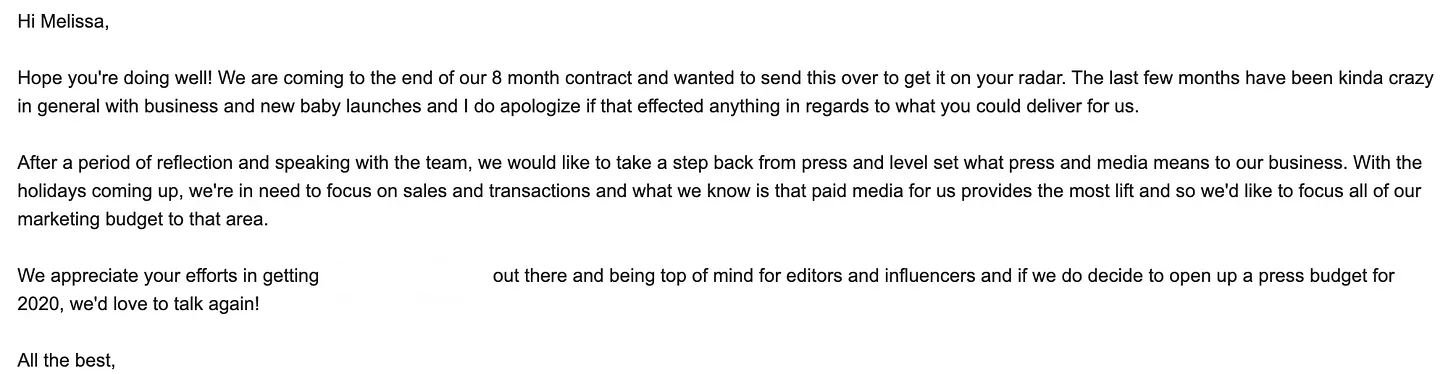
This is a really nice breakup email from a client who got over their skis and was honest about it. Sometimes you think it’s the right time for PR for your brand, and the right brand for you to work on, and it just doesn’t align; no harm, no foul.
The $6,000 client didn’t really know why they hired a PR firm. There were no KPIs. No shared definition of success. The CEO didn’t have time for regular calls, and there weren’t enough people internally to support what I was doing.
When you can’t get stakeholders to make time for you, you’re never going to win. That’s not personal. It just shows you where priorities actually live.
We built an incredible online community and landed major editorial coverage, Today Show, Vogue, and everywhere else it was included. But internally, none of it carried as much weight as a single mediocre blog post from a small creator. When the strategy shifted to creator content, there were always questions about where the editorial went (it was still coming; they just weren’t paying attention because they couldn’t).
There was no hierarchy, no strategy, and no clarity around what PR was meant to do and unlock next.
When they left, they didn’t renew our contract; instead, they said they were taking a break to reevaluate PR. Then they went to a friend’s agency a few months later that specialized in celebrity dressing. That was the next phase of their business. Instead of articulating that shift, instead of saying this is where we’re headed, they just moved on.
At the time, it felt confusing. In hindsight, it makes perfect sense.
They didn’t know what success looked like, so they couldn’t recognize it when they had it; there was no benchmarking and no outcome goals. Just a spaghetti at a wall to see what stuck.
The Client Who Wanted Fame, Not Press

The $7,000 client was an infrared sauna spa and they were the opposite.
They didn’t ride a trend; they created one, and sauna beds became the wellness moment of 2018. When we started working together, they had two locations in LA and were opening their first in New York. From there, it moved fast as they grew to five locations in NY, including East Hampton, and four in LA, with endless press, wild momentum, and more in the pipeline.
Editors, influencers, celebrities, everyone wanted in, and my phone was constantly blowing up with requests. It was like drinking from a firehose, and we loved it!
Then one article ran that the founder didn’t like.
She asked me to call the writer and editor to get it changed. Anyone in PR knows this isn’t simple, and it rarely comes without consequences.
I was caught between the long game and the short game. Protect relationships I’d spent years building, not just for this client but for every future one, or make my client happy in the moment.
I made the call, and it was the wrong one. Looking back, I knew it was the wrong thing to do at the time, but against my better judgment and in the interest of making my clients happy, I called the writer and her editor.
The relationship with that writer and editor was never the same. I knew immediately that future opportunities were likely gone, not just for that brand but for others, too.
In the end, it didn’t matter.
The founder cancelled the contract anyway after a larger agency came in after everything I had done to lay the foundation and grow the brand, and said something I still remember word for word:
“You’re big time now. You need a bigger agency. We can make you famous.”
They paid me for two months and ghosted me for the last one as they transitioned to their new agency.
At the time, it felt really personal, we had built so much together but it wasn’t. It was about greener grass. That happens a lot in PR.
What Losing $13,000 a Month Teaches You
As a freelancer, that kind of ending is brutal. You can have months where you make $20,000 and months where you make $2,000. There’s no buffer and sometimes no safety net. When something ends abruptly, it’s not just emotional; it can have HUGE financial consequences.
That experience taught me something I wish I’d understood earlier.
Choosing the right clients matters just as much as being chosen by them.
I think about one of my earliest clients who paid a friend and me $10,000 a month to “get press.” It seemed like a win, but the product wasn’t good, the strategy didn’t exist, and they didn’t really know what they were building or for whom. They just assumed PR would sell it out, and it was a no-win situation from the start.
Early in your career, you say yes because you have to. It’s survival. Over time, the work teaches you discernment.
What Actually Makes a Good Client
Now, when I evaluate a potential client, I come back to the same things every time, to the point that I created an SOP for our team so they know what to look for when speaking with brands.
A good client:
And then there’s my personal filter.
Do I like this product enough to sell it?
Does my team agree?
And would I actually want to have dinner with these people?
If I can answer all three confidently, I know we’ll align on a meaningful level that could be the start of a great working relationship. The rest still has to work, budget, timeline, goals, and strategy, but without those three, the rest becomes a risk I’m no longer willing to take.
No one wants to work with people who aren’t invested in shared goals. Sometimes these misalignments are disguised at the outset, and other times priorities simply shift until you're no longer part of the equation. But remember: choosing a client is a two-way street, and ultimately, your success is their success.
The Fine Print
Early in your career, you say yes because you have to; discernment comes later.
You’re building a body of work to show your experience, cash flow, and confidence, so eventually, choosing clients becomes less about chasing the win and more about protecting the work and the people doing it.
Every “yes” sets the tone for your days, your energy, your reputation, and future opportunities. Every “no” makes room for something better, and it aligns them with what they say: “rejection is really redirection,” and I believe that.
That’s the fine print most people (unfortunately) only learn by living it.